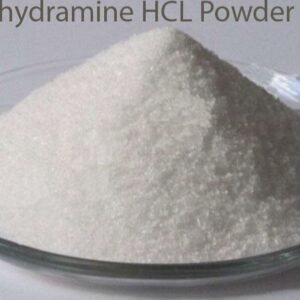
Diphenhydramine hydrochloride Powder 99% CAS 147-24-0
- Estimated Delivery : Up to 4 business days
- Free Shipping & Returns : On all orders over $200
ThiBuy diphenhydramine powder online,Diphenhydramine Citrate (USP grade powder) chemical reference substance
Diphenhydramine is a first-generation antihistamine used to treat mainly allergies. Like most other first-generation antihistamines, the drug also has a powerful hypnotic effect, and for this reason is often used as a nonprescription sleep aid and a mild anxiolytic
| Diphenhydramine blocks tetrodotoxin-sensitive (TTX-S) and tetrodotoxin-resistant (TTX-R) sodium currents with K(d) values of 48 mM and 86 mM, respectively, at a holding potential of -80 mV. Diphenhydramine shifts the conductance-voltage curve for TTX-S sodium currents in the depolarizing direction but has little effect on that for TTX-R sodium currents. Diphenhydramine causes a shift of the steady-state inactivation curve for both types of sodium currents in the hyperpolarizing direction. Diphenhydramine produces a profound use-dependent block when the cells are repeatedly stimulated with high-frequency depolarizing pulses. [1]
Diphenhydramine induces apoptosis in a dose- and time-dependent manner in both CCRF-CEM and Jurkat cell lines, whereas Cimetidine fails to induce significant effects at similar concentrations. Diphenhydramine-induced apoptosis is evaluated in terms of morphology, flow cytometry, and the release of cytochrome c to the cytosol. Diphenhydramine inhibits cell proliferation without inducing apoptosis in human peripheral blood mononuclear cells. [2] Diphenhydramine (500 nM) significantly reduces the baseline firing of the periaqueductal gray neurons without a significant effect on the frequency of postsynaptic potentials. Diphenhydramine at high concentration inhibits periaqueductal gray neurons, but at low concentrations it has no effect on the baseline-firing rate and it blocks the response to neurotensin and tomedial preoptic nucleus stimulation. [3] |
How should I use this medication?
Place this medication on the tongue and then drink a glass of water. You may also mix the powder into a glass of water or other drink and then drink it. Take it as directed on the label. Do not take it more often than directed.
Talk to your care team about the use of this medication in children. While it may be given to children as young as 12 years for selected conditions, precautions do apply.
Buy diphenhydramine powder online
Overdosage: If you think you have taken too much of this medicine contact a poison control center or emergency room at once.
NOTE: This medicine is only for you. Do not share this medicine with others.
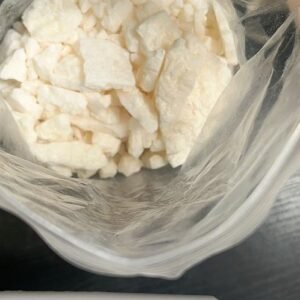
Diphenhydramine hydrochloride has the appearance of a white crystalline powder. is odorless and has a bitter, numbing taste. It is soluble in water and aqueous solutions are acidic. It has a melting point of 166–169 °C and the boiling point ranges from 150 to 165 °C at 2E0 mmHg. Diphenhydramine has a water solubility of 3060 mg l−1 at 37 °C. Density is 1.013–1.012. Log P is 3.27. The pKa is 8.98 and the Log S is −3.5. Refractivity is 79.93 and polarizability is 29.
Diphenhydramine is fairly stable in the environment although it does undergo photodegradation. Conjugates of diphenhydramine such as diphenhydramine-N-glucuronide may be converted back to the parent compound, diphenhydramine,
through enzymatic cleavage during sewage treatment process. Diphenhydramine is removed poorly through wastewater treatment processes and is found in significant concentrations in aquatic organisms downstream from such plants.
Diphenhydramine has significant risk for bioaccumulation, particularly in water downstream from wastewater and sewage treatment facilities.
| Quantité | 1Kg |
|---|
Produits connexes
-
 Sélectionnez les options Ce produit a plusieurs variantes. Les options peuvent être choisies sur la page de produit
Etonitazene Powder
Plage de prix : 700$ à 15,000$ -
TDP 1.5 Tablet Press Machine
Le prix initial était : 8,000$.7,500$Le prix actuel est : 7,500$. -
 Sélectionnez les options Ce produit a plusieurs variantes. Les options peuvent être choisies sur la page de produit
ADB-FUBINACA (ADB-F)
Plage de prix : 3,500$ à 6,500$ -
 Sélectionnez les options Ce produit a plusieurs variantes. Les options peuvent être choisies sur la page de produit
Ethylbromazolam Powder CAS#105470-75-5
Plage de prix : 350$ à 12,800$ -
 Sélectionnez les options Ce produit a plusieurs variantes. Les options peuvent être choisies sur la page de produit
4-HO-MET(4-hydroxy-N-methyl-N-ethyltryptamine)
Plage de prix : 350$ à 13,000$